Choosing the right materials for custom metal parts is one of the most important decisions before production. Material selection affects strength, weight, corrosion resistance, machinability, appearance, surface finish, production cost, and the long-term performance of the final product.
For many custom projects, the best material is not always the strongest or most expensive option. A lightweight aluminum part may be better for a fixture or enclosure. Stainless steel may be better for a part exposed to moisture. Carbon steel may be practical for a strong bracket or frame. Brass or copper may be selected for appearance, conductivity, or special functional requirements.
This guide explains how to choose materials for custom metal parts and what information customers should prepare before requesting a quotation.
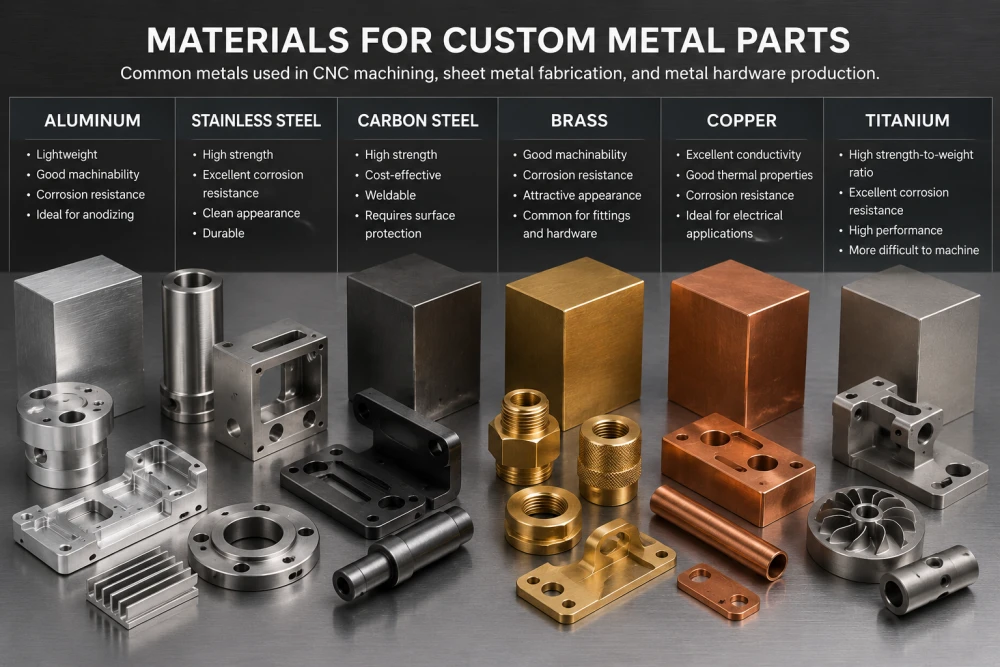
Why Material Selection Matters for Custom Metal Parts
Custom metal parts are usually made for a specific product or application. This means the material must match the real working conditions of the part. A component used inside a machine may need dimensional stability and strength. A display part may need a clean appearance. A housing may need corrosion resistance. A bracket may need load-bearing strength and reliable mounting holes.
If the wrong material is selected, the part may be too weak, too heavy, too expensive, difficult to machine, hard to finish, or unsuitable for the working environment. That is why material selection should be reviewed together with the part design, manufacturing process, surface finish, quantity, and application.
Key Factors When Choosing Materials
Before selecting materials for custom metal parts, it is useful to review several practical factors. These factors help determine whether a material is suitable for CNC machining, sheet metal fabrication, metal hardware production, brackets, enclosures, panels, or decorative metal products.
1. Strength and Load Requirements
If the part needs to support weight, resist pressure, hold another component, or work as a structural part, strength is important. Carbon steel and stainless steel are commonly used for stronger brackets, frames, supports, and mounting structures. Aluminum can also be used when the design is suitable and weight reduction is important.
2. Weight
Weight matters for equipment, portable products, fixtures, electronic housings, and moving assemblies. Aluminum is often selected when the part needs to be lighter but still strong enough for the application. This is one reason aluminum is widely used for machined housings, plates, panels, and custom brackets.
3. Corrosion Resistance
If the part will be exposed to moisture, outdoor conditions, chemicals, or frequent handling, corrosion resistance should be considered. Stainless steel is commonly selected for corrosion resistance. Aluminum can also perform well with proper anodizing or coating. Carbon steel usually needs plating, painting, powder coating, or another protective finish.
4. Machinability
Machinability affects production difficulty, tool wear, surface quality, and machining cost. Aluminum is usually easier to machine than many steels. Brass also has good machinability. Stainless steel and titanium may require more careful machining because they are more difficult to process.
5. Appearance
For visible metal parts, appearance can be just as important as function. Stainless steel can be brushed or polished for a clean surface. Aluminum can be anodized in different colors. Brass and copper have natural decorative value. Surface finish should be considered together with material selection.
6. Cost
Material cost and processing cost both affect the final quotation. Carbon steel is often cost-effective for structural parts. Aluminum is practical for many machined parts. Stainless steel, brass, copper, and titanium may cost more depending on grade, size, process, and finishing requirements.
Common Materials for Custom Metal Parts
Aluminum
Aluminum is one of the most common materials for custom metal parts. It is lightweight, easy to machine, and suitable for many surface finishes, especially anodizing. Aluminum is often used for CNC machined parts, housings, panels, fixtures, brackets, plates, and prototype components.
Aluminum is a good choice when the part needs lower weight, good machinability, clean appearance, and reasonable corrosion resistance. It is widely used in machinery, electronics, automation, product development, and commercial applications.
Stainless Steel
Stainless steel is selected when strength, corrosion resistance, durability, and appearance are important. It is commonly used for brackets, covers, panels, hardware, decorative parts, food-related equipment parts, and components used in demanding environments.
Stainless steel can be brushed, polished, passivated, or finished in different ways. It is stronger than aluminum but usually heavier and more difficult to machine. For visible or long-life parts, stainless steel can be a very practical material.
Carbon Steel
Carbon steel is strong, practical, and cost-effective. It is commonly used for structural components, frames, supports, brackets, mounting plates, welded parts, and industrial hardware. It is especially useful when strength is more important than weight.
Because carbon steel can rust, surface treatment is usually needed. Common finishes include powder coating, painting, zinc plating, black oxide, and other protective coatings. For many industrial applications, carbon steel offers a good balance between strength and cost.
Brass
Brass is often used for fittings, bushings, connectors, decorative parts, precision machined components, and hardware products. It has good machinability and an attractive yellow-metal appearance.
Brass is useful when the part needs a decorative look, good wear resistance, or smooth machining performance. It can be polished or plated depending on the final appearance requirement.
Copper
Copper is commonly selected for electrical conductivity, thermal conductivity, and special appearance. It can be used for electrical contact parts, heat transfer components, decorative products, and selected machined parts.
Copper is softer than many other metals and may require careful handling during machining and finishing. It is not usually chosen only for strength, but it is valuable when conductivity or appearance matters.
Titanium
Titanium is used for special applications where strength-to-weight performance and corrosion resistance are important. It is lighter than steel, strong, and resistant to many harsh environments.
However, titanium is more expensive and more difficult to machine than aluminum or carbon steel. It is usually selected only when the application justifies the higher material and processing cost.

How Surface Finish Affects Material Choice
Surface finish is closely connected with material selection. The same finish may not be suitable for every metal. For example, aluminum is often anodized. Stainless steel is often brushed or polished. Carbon steel often needs coating or plating. Brass and copper may be polished, plated, or treated for decorative effects.
Common surface finishes for custom metal parts include anodizing, electroplating, polishing, brushing, sandblasting, powder coating, painting, passivation, black oxide, and laser marking. The purpose may be appearance improvement, rust prevention, wear resistance, branding, or surface protection.
If the part will be visible to the customer, the finish should be confirmed early. If the part will be used inside machinery, the finish may focus more on protection, friction, cleanliness, or durability.
Choosing Materials by Application
For CNC Machined Parts
Aluminum, stainless steel, brass, copper, titanium, and selected steels can be used for CNC machined parts. Aluminum is often selected for lightweight and easy machining. Stainless steel is used for strength and corrosion resistance. Brass is practical for fittings and small precision parts. Copper is used when conductivity matters.
For Sheet Metal Parts
Sheet metal parts often use stainless steel, carbon steel, aluminum, or galvanized steel. These materials can be cut, bent, punched, formed, welded, and finished. They are commonly used for brackets, enclosures, panels, chassis, covers, and frames.
For Metal Brackets and Hardware
Metal brackets and hardware parts usually require strength, stable dimensions, and reliable mounting points. Carbon steel, stainless steel, and aluminum are common choices. The right material depends on load, environment, thickness, surface finish, and cost.
For Decorative Metal Products
Decorative metal products may use stainless steel, aluminum, brass, or copper. Appearance, color, texture, polishing, brushing, plating, and coating are important. These parts may be used for signs, display stands, ornaments, nameplates, and commercial products.
What Information Should You Send Before Quotation?
To choose the right material and prepare a practical quotation, customers should provide drawings, samples, photos, product dimensions, material preference, quantity, surface finish, and application information.
If you already know the material grade, include it in the inquiry. If you are not sure, describe how the part will be used. For example, tell the supplier whether the part is used indoors or outdoors, whether it carries load, whether appearance matters, whether it needs corrosion resistance, and whether it will be assembled with other parts.
Useful quotation information includes:
- 2D drawings, 3D files, samples, photos, or sketches
- Material type or material grade if available
- Quantity for prototype, sample, small batch, or production order
- Surface finish requirement
- Tolerance or important dimensions
- Final application or working environment
Material Selection Should Match the Real Product
There is no single best metal for every custom part. A good material choice should match the product design, use environment, production method, surface finish, and cost target. For some projects, aluminum is the best choice. For others, stainless steel, carbon steel, brass, copper, or titanium may be more suitable.
The most practical way is to review material selection together with the drawing and application. This helps avoid unnecessary cost, production problems, poor surface finish, or unsuitable performance.
Work with Machined Parts Pro
Machined Parts Pro supports custom metal parts made from aluminum, stainless steel, carbon steel, brass, copper, titanium, and other materials according to project requirements. Our product scope includes CNC machined parts, sheet metal parts, metal hardware, brackets, enclosures, panels, decorative metal products, and small-batch custom components.
If you are not sure which material is suitable for your part, you can send your drawing, sample photo, product idea, material requirement, quantity, surface finish, and application details. We will help review your project and provide a practical quotation.
Related Application Example
CNC machined parts and sheet metal parts are often used together in automation equipment. A machine may use machined shafts, flanges, housings, and mounting plates together with servo motors, planetary gearboxes, and rotary positioning modules.
For motion transmission projects, buyers can also compare planetary gearbox options and hollow rotary table solutions when designing automation systems that require torque transmission, indexing, or precision positioning.
Need Help Choosing Materials?
Send your drawing, product idea, material requirement, quantity, surface finish, and application details. We will help review your custom metal parts project.
Request a Material ReviewView Metal Materials | View Custom Metal Products | View Manufacturing Capabilities | Request a Quote