CNC machined parts and sheet metal parts are both widely used in custom metal manufacturing. They can both be made from metals such as aluminum, stainless steel, carbon steel, brass, copper, and other materials. However, they are produced by different processes and are suitable for different product structures, tolerance requirements, quantities, costs, and applications.
For buyers, engineers, and product developers, understanding the difference between CNC machined parts and sheet metal parts can make quotation and production decisions much easier. A part with complex 3D geometry may be better for CNC machining. A formed enclosure or bracket may be better for sheet metal fabrication. Some products may even require both processes.
This guide compares CNC machined parts vs sheet metal parts and explains how to choose the right manufacturing method for your custom metal project.

What Are CNC Machined Parts?
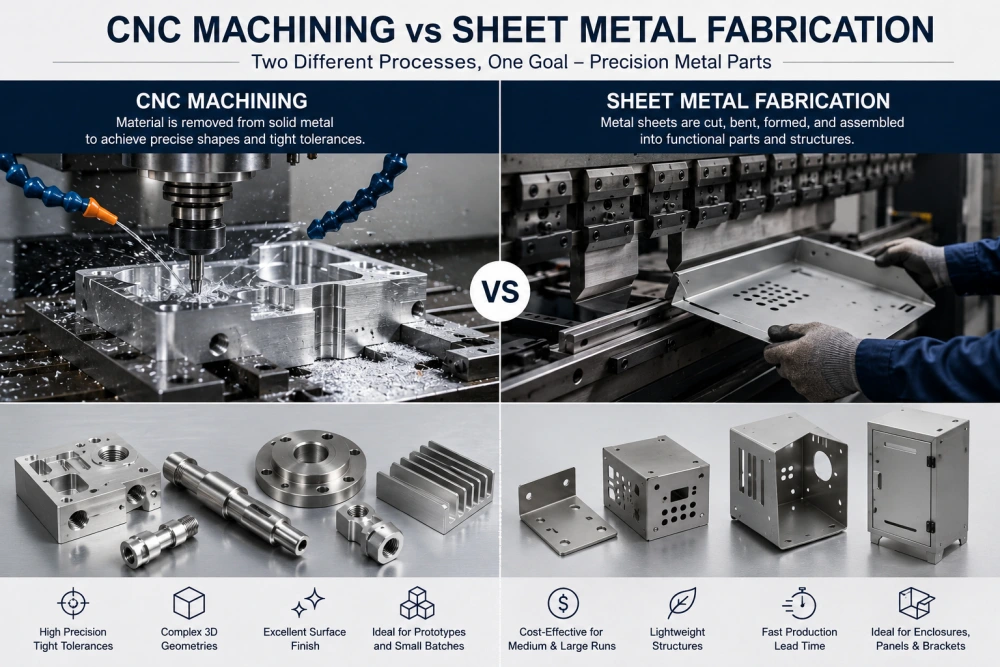
CNC machined parts are metal components made by removing material from a solid block, bar, plate, or billet using computer-controlled cutting tools. CNC machining can include CNC milling, CNC turning, drilling, tapping, boring, slotting, and other precision cutting operations.
This process is commonly used when parts need accurate dimensions, complex 3D shapes, holes, threads, grooves, pockets, flat surfaces, curved surfaces, tight fits, or precise assembly features. CNC machining is especially useful for prototypes, small-batch parts, mechanical components, housings, shafts, bushings, spacers, blocks, plates, fixtures, and precision metal products.
Common CNC machined materials include aluminum, stainless steel, carbon steel, brass, copper, titanium, and engineering metals. Aluminum is often selected for lightweight machined parts, while stainless steel is chosen for strength and corrosion resistance.
What Are Sheet Metal Parts?
Sheet metal parts are made from flat metal sheets that are cut, punched, bent, formed, welded, riveted, or assembled into the required shape. Sheet metal fabrication is suitable for parts with relatively uniform thickness and folded or formed structures.
Common sheet metal products include brackets, panels, covers, enclosures, chassis, frames, guards, housings, mounting plates, electrical boxes, equipment covers, and structural supports. Compared with CNC machining, sheet metal fabrication is usually more suitable for larger, thinner, formed parts.
Common sheet metal materials include stainless steel, carbon steel, aluminum, galvanized steel, and sometimes brass or copper depending on application and appearance requirements.
Main Difference Between CNC Machined Parts and Sheet Metal Parts
The biggest difference is how the part is formed. CNC machining removes material from a solid piece of metal. Sheet metal fabrication shapes flat sheet material by cutting, bending, forming, welding, and assembly.
CNC machining is more suitable for solid, thick, complex, or precision parts. Sheet metal fabrication is more suitable for thin-walled, folded, formed, or enclosed structures.
For example, a precision aluminum block with pockets, threaded holes, and tight tolerance surfaces is usually a CNC machined part. A metal enclosure with bent sides, ventilation slots, and mounting holes is usually a sheet metal part.
Comparison by Shape and Structure
CNC machining offers more freedom for complex 3D shapes. It can create deep pockets, curved surfaces, accurate holes, threads, grooves, steps, and complex machined features. If the part looks like it must be carved from a solid block or bar, CNC machining is often the better choice.
Sheet metal fabrication is better for parts made from plates or sheets. If the part has flat panels, bends, folded edges, mounting flanges, cutouts, slots, and relatively uniform wall thickness, sheet metal fabrication is usually more practical.
A simple way to judge is this: if the part is mainly a solid shape, consider CNC machining. If the part is mainly a folded or formed sheet structure, consider sheet metal fabrication.
Comparison by Tolerance
CNC machining is generally better for parts requiring tighter tolerances, accurate fits, precision holes, threaded features, flatness control, and mechanical assembly accuracy. When a part must connect with bearings, shafts, fasteners, motors, sensors, or other precision components, CNC machining is often preferred.
Sheet metal fabrication can also achieve good accuracy, but the process involves bending and forming, which may create more variation than machining. Bend radius, material thickness, springback, tooling, and welding can all affect final dimensions.
This does not mean sheet metal parts are inaccurate. It means the design tolerance should match the manufacturing process. Tight tolerance should be used only where necessary, especially for holes, mounting points, and assembly features.
Comparison by Cost
Cost depends on material, size, quantity, complexity, tolerance, finish, and production method. CNC machining can be cost-effective for prototypes, small batches, and precision components, but it may become expensive when a lot of material must be removed or machining time is long.
Sheet metal fabrication can be cost-effective for panels, brackets, covers, enclosures, and formed structures, especially when the part design is suitable for cutting and bending. However, welding, polishing, special tooling, tight tolerances, and complex assembly can increase cost.
For simple flat brackets, sheet metal fabrication may be cheaper. For complex solid blocks or precision components, CNC machining may be more suitable even if the unit price is higher.
Comparison by Material Use
CNC machining starts from solid stock, so material waste can be higher when the final part removes a large amount of metal. However, CNC machining can achieve strong, accurate, and complex parts from solid material.
Sheet metal fabrication starts from flat sheets, so it can be more material-efficient for covers, panels, brackets, and enclosures. The thickness is usually consistent, and the part is shaped by bending or forming rather than removing large volumes of material.
If material cost is important, the design should be reviewed carefully to decide whether the part can be made from sheet metal instead of machining from a solid block.
Comparison by Surface Finish
Both CNC machined parts and sheet metal parts can use surface finishing. Common finishes include anodizing, polishing, brushing, electroplating, powder coating, painting, sandblasting, passivation, black oxide, and laser marking.
CNC machined aluminum parts are often anodized for corrosion resistance and appearance. Stainless steel machined parts may be brushed or polished. Sheet metal parts are often powder coated, painted, plated, brushed, or polished depending on material and application.
If the part is visible to the end user, surface finish should be confirmed early. Appearance parts may need more careful polishing, brushing direction, color consistency, or coating control.
When Should You Choose CNC Machined Parts?
CNC machined parts are usually a good choice when the part requires precision, complex solid geometry, tight fits, accurate holes, threads, pockets, grooves, or mechanical function.
You may choose CNC machining for:
- Precision aluminum housings and blocks
- Shafts, bushings, spacers, and fittings
- Parts with tight tolerance features
- Complex 3D machined shapes
- Prototype or small-batch precision components
- Mechanical parts requiring accurate assembly
When Should You Choose Sheet Metal Parts?
Sheet metal parts are usually a good choice when the product is made from flat metal sheet and requires cutting, bending, forming, welding, or assembly.
You may choose sheet metal fabrication for:
- Metal brackets and mounting plates
- Equipment covers and panels
- Electrical enclosures and chassis
- Frames, guards, and housings
- Ventilated covers and formed structures
- Cost-effective folded metal components
Can One Product Use Both Processes?
Yes. Many custom metal products use both CNC machining and sheet metal fabrication. For example, an enclosure may use sheet metal panels for the outer structure and CNC machined inserts for accurate mounting points. A machine assembly may use sheet metal covers and CNC machined shafts, blocks, or brackets.
Using both processes can be practical when the product needs the cost efficiency of sheet metal and the precision of CNC machining. The best solution depends on the drawing, function, tolerance, appearance, and final application.
What Information Is Needed for a Quote?
To decide whether a part should be CNC machined or sheet metal fabricated, customers should provide drawings, samples, photos, dimensions, material, quantity, tolerance, surface finish, and application details.
If you are not sure which process is suitable, you can send a simple description and explain how the part will be used. A supplier can review the part shape and suggest whether CNC machining, sheet metal fabrication, or a combined process is more practical.
Useful quotation information includes:
- 2D drawing, 3D file, sample photo, or sketch
- Material type and thickness if known
- Quantity for prototype, small batch, or production
- Important dimensions and tolerance requirements
- Surface finish requirements
- Application and assembly conditions
How to Choose the Right Process
The right choice depends on the part structure, function, material, tolerance, quantity, cost target, and surface finish. There is no single process that is best for every custom metal part.
Choose CNC machining when the part requires high precision, complex solid geometry, or accurate mechanical features. Choose sheet metal fabrication when the part is mainly a folded, formed, or fabricated sheet structure.
If the design includes both precision areas and formed sheet structures, a combined manufacturing method may be the best option.
Work with Machined Parts Pro
Machined Parts Pro supports both CNC machined parts and sheet metal parts for industrial and commercial applications. Our product scope includes precision machined components, sheet metal brackets, enclosures, panels, metal hardware, mounting parts, decorative metal products, and small-batch custom components.
If you are not sure whether CNC machining or sheet metal fabrication is suitable for your project, you can send your drawing, sample photo, product idea, material, quantity, surface finish, and application details. We will help review the design and provide a practical quotation.
Related Application Example
CNC machined parts and sheet metal parts are often used together in automation equipment. A machine may use machined shafts, flanges, housings, and mounting plates together with servo motors, planetary gearboxes, and rotary positioning modules.
For motion transmission projects, buyers can also compare planetary gearbox options and hollow rotary table solutions when designing automation systems that require torque transmission, indexing, or precision positioning.
Need CNC Machined Parts or Sheet Metal Parts?
Send your drawing, product idea, material, quantity, surface finish, and application details. We will help review the suitable manufacturing process for your custom metal parts.
Request a QuoteView Manufacturing Capabilities | View Custom Metal Products | View Metal Materials | Request a Quote